
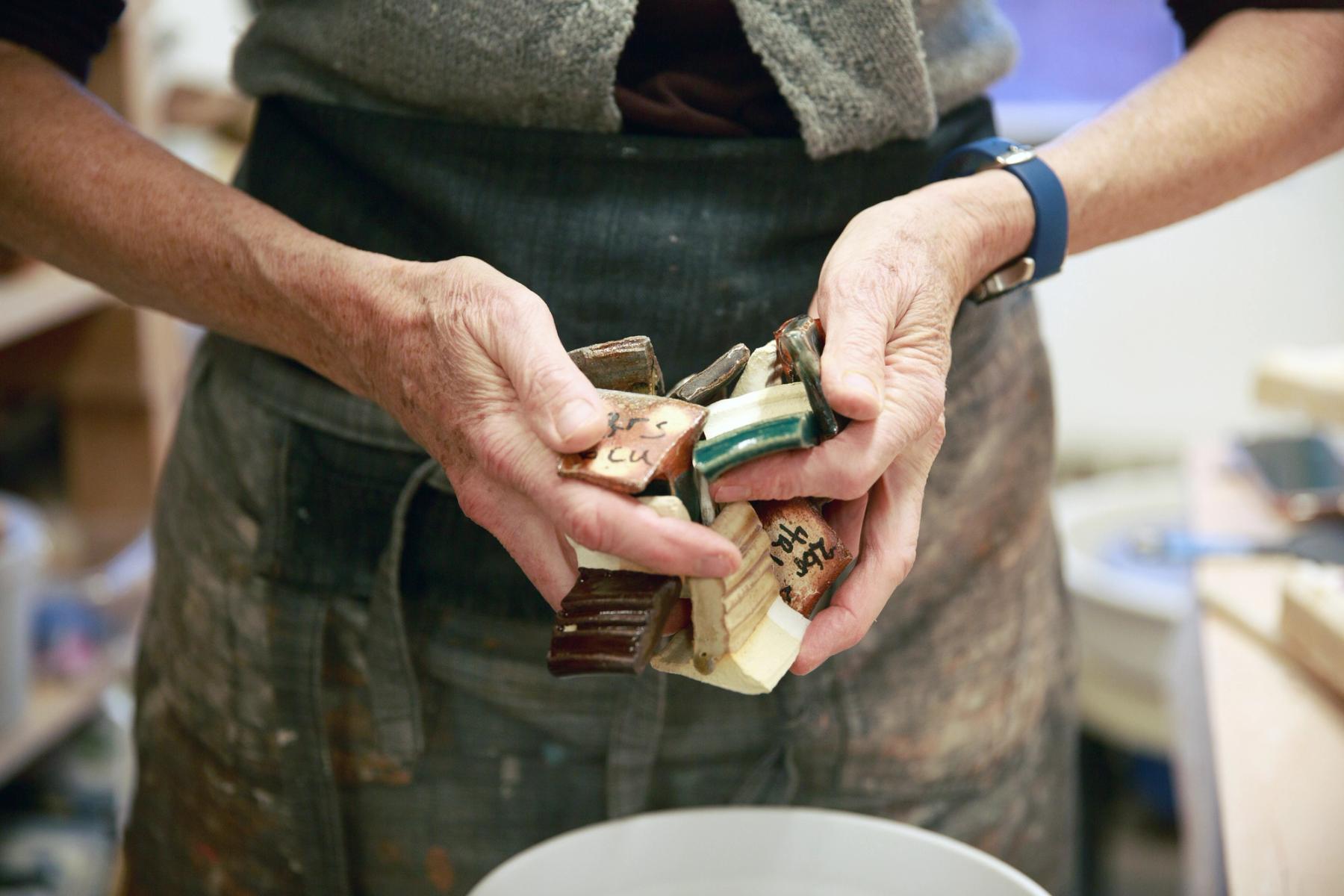
Photo by Natalie Conn, Salt ’07
Margo Halverson on how creative practice evolves
For more than three decades, Margo Halverson served as Program Chair of Graphic Design at Maine College of Art & Design. After retiring in December 2023, she returned to campus, not as a professor emerita, teacher, or critic, but as a Bachelor of Fine Arts (BFA) student in Ceramics. While her transition from graphic design to clay may seem unusual, to Halverson it reflects the creative inquiry that has guided her entire career.
Halverson’s narrow studio, tucked away on the 5th floor of MECA&D’s Porteous Building alongside other ceramics majors, overflows with the spoils of her prolific clay process. On the left, vessels of all shapes and sizes peer out from packed shelves. To the right, her canvas-covered table is peppered with glaze test tiles beneath a bulletin board replete with inspirational images and glaze recipes.
“I don’t really consider working in clay a transition, but rather it's an evolution,” she shares, perched on a studio stool. “I'm just making ideas visual in a new material.”
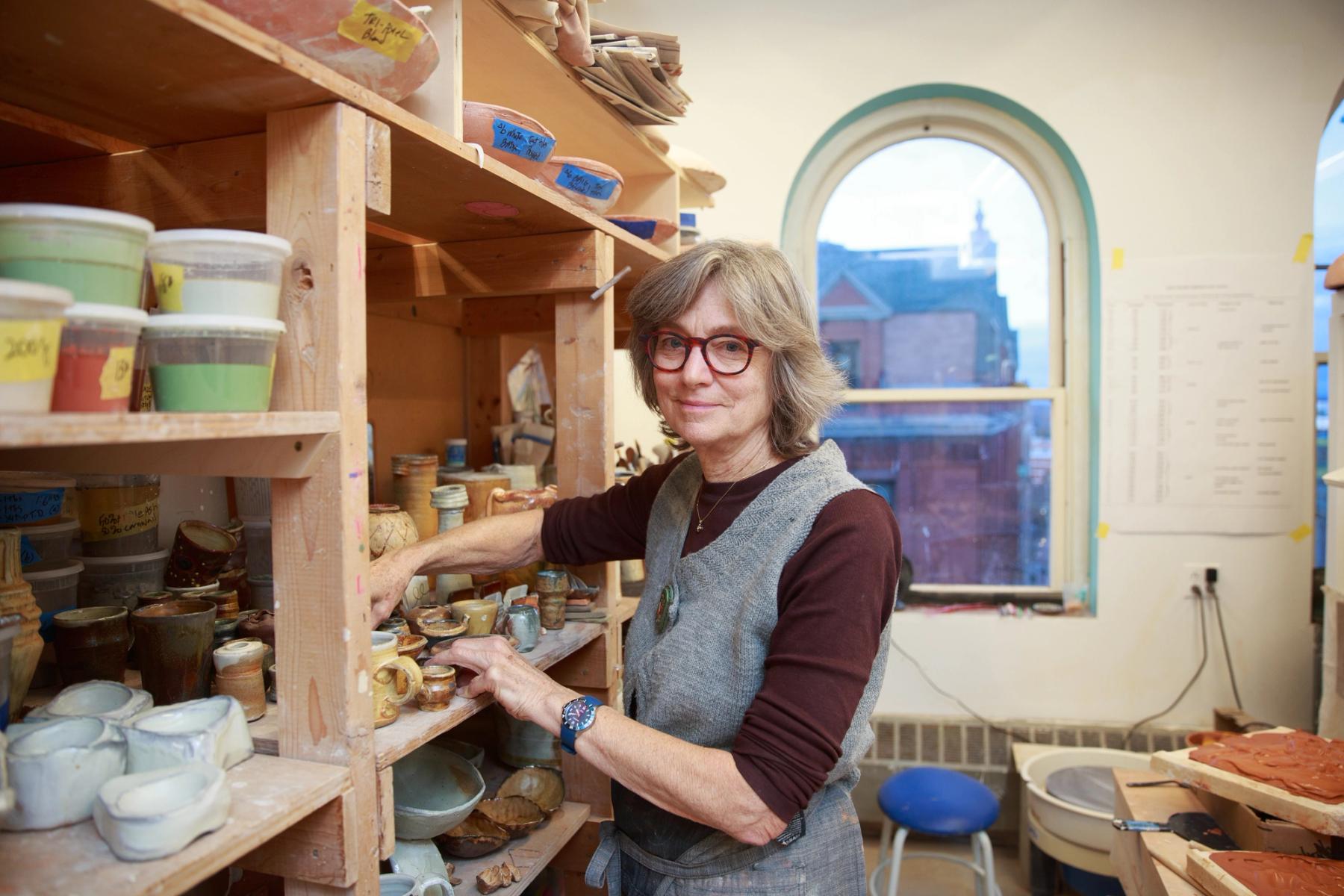
Photo by Natalie Conn, Salt ‘07
Not one to take the direct route, Halverson entered the world of design after earning a BFA and Master of Fine Arts in Photography at Arizona State University (ASU). When she expressed interest in creating photo books, a portfolio reviewer suggested she study graphic design—a discipline that Halverson had never heard of, much less considered. She returned to ASU at the age of 27 (feeling “old” at the time), and set about building a foundation in this new discipline.
Upon completing her studies in the late 1980’s, Margo joined the graphic design field during a time of rapid transition. What had been a vocation rooted in cutting, pasting, and photo typesetting steadily shifted to the digital realm. After beginning her teaching job at Maine College of Art & Design, Margo continued to evolve with the discipline while maintaining her own design studio in partnership with her husband, Charles Melcher. But as the days of laying out work by hand gave way to hours in front of a computer, she sought a counterbalance to the requisite screen time. MECA&D’s Continuing Studies classes in ceramics served as a necessary antidote. Clay offered an opportunity to work with her hands and a different set of constraints within which to iterate and experiment.
“Keeping my hands in clay versus figuring out how technology would impact my profession, as well as how to integrate it into the curriculum, was a welcome departure.”
The classes also served a secondary purpose: they provided a place to develop a creative community. Any artist or designer knows that professional and peer connections are a critical counterpart to making work. However, building meaningful relationships can sometimes elude even the most socially oriented.
“When I moved to Portland, I knew no one. I thought I'd take an evening class in ceramics. So I had classes with (fellow MECA&D professors) Mark Johnson, Lucy Breslin, and Marion Baker. I had all the greats.
“My teachers were also my peers, who became my friends, which was not unusual for me or for this place.”
Halverson is also the co-founder of DesignInquiry, a non-profit collective engaged in redefining how designers work together. Through DesignInquiry, she has developed opportunities to foster dialogue, connection, and growth that have influenced creative communities across the country and abroad. This unique approach to design research can be applied to any medium. Without the need to distinguish between student and teacher, anyone approaching a process or project with curiosity can learn and impart knowledge simultaneously.
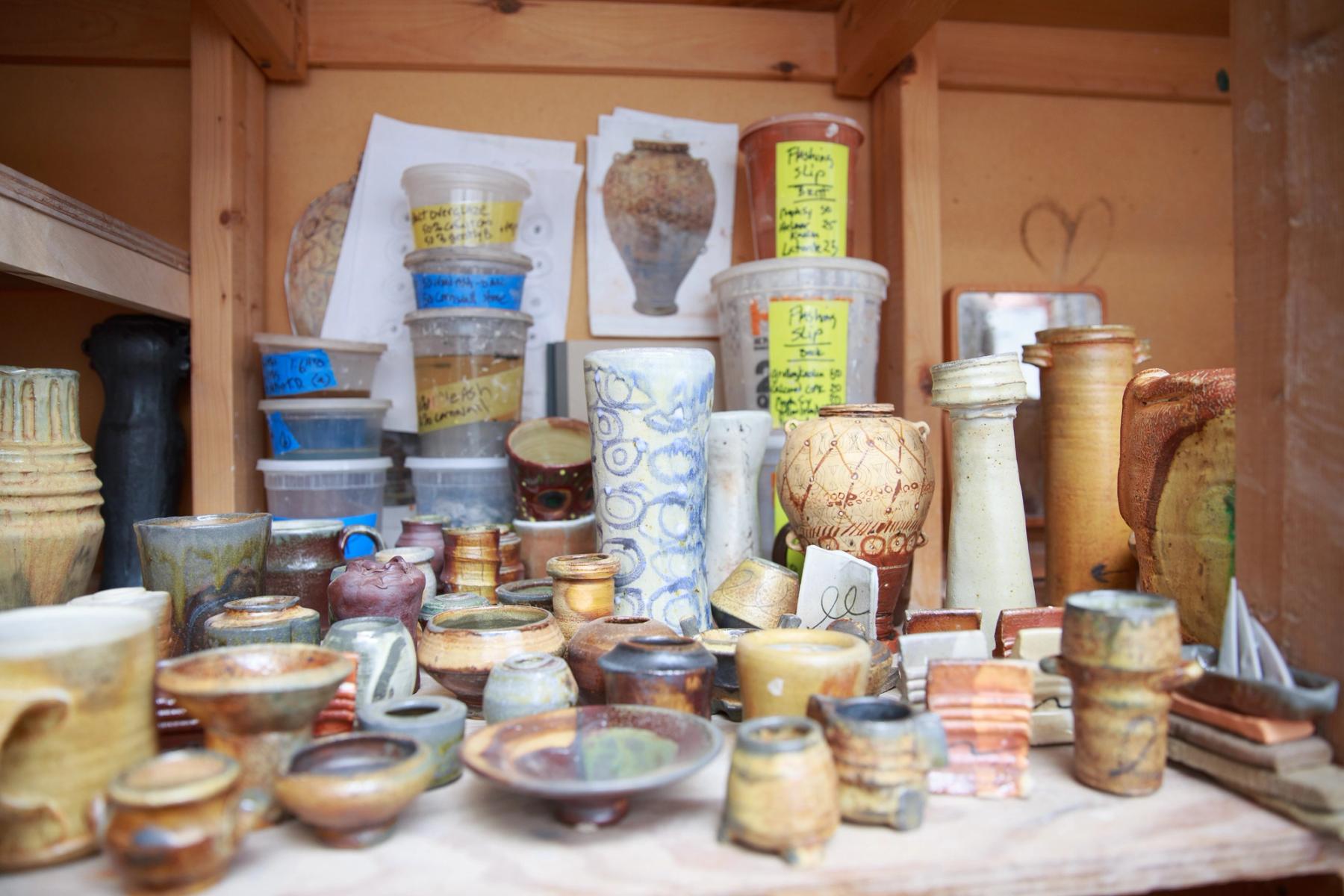
Photo by Natalie Conn, Salt ‘07
Both clay and design require navigating a balance between idea and material, intention and accident. They demand that the maker stay alert to subtle shifts—whether in the dynamics of a layout or the behavior of a particular clay body. These parallels aren’t always obvious but reveal themselves through a visual vocabulary developed over years of practice. “You realize your references follow you,” Halverson shares. “Your eye stays your eye, no matter what you’re making.
“In graphic design, you have to be constantly listening, and also picturing the receiver. With clay, it’s similar in that you involve the user, especially in functional work. It’s similar in the process of responding to what’s in front of you. The thing you make is the artifact of the idea; for life and expression, it needs to remain alive, which happens when you are responding all along the process without chasing preconceived results.”
For anyone considering a return to creative practice or plunging into a new medium, Halverson offers some simple guidance: Let process lead; whether at the wheel or on the screen, the act of making reveals its own direction. And above all, put in the work, find an attitude of play, and just do it.
“During my 32 years of full-time teaching at MECA&D, I sometimes would talk about ceramics, or I would suggest that a student take a course, so that they understand process. That it isn't about the thing you create, it's about all of those pieces along the way that get you there.”
Returning to clay was not a departure for Halverson but a reaffirmation that creative practice offers lifelong opportunities for evolution. Creative work, regardless of medium, welcomes possibilities that emerge and to begin again.
Words by Claire Brassil.