
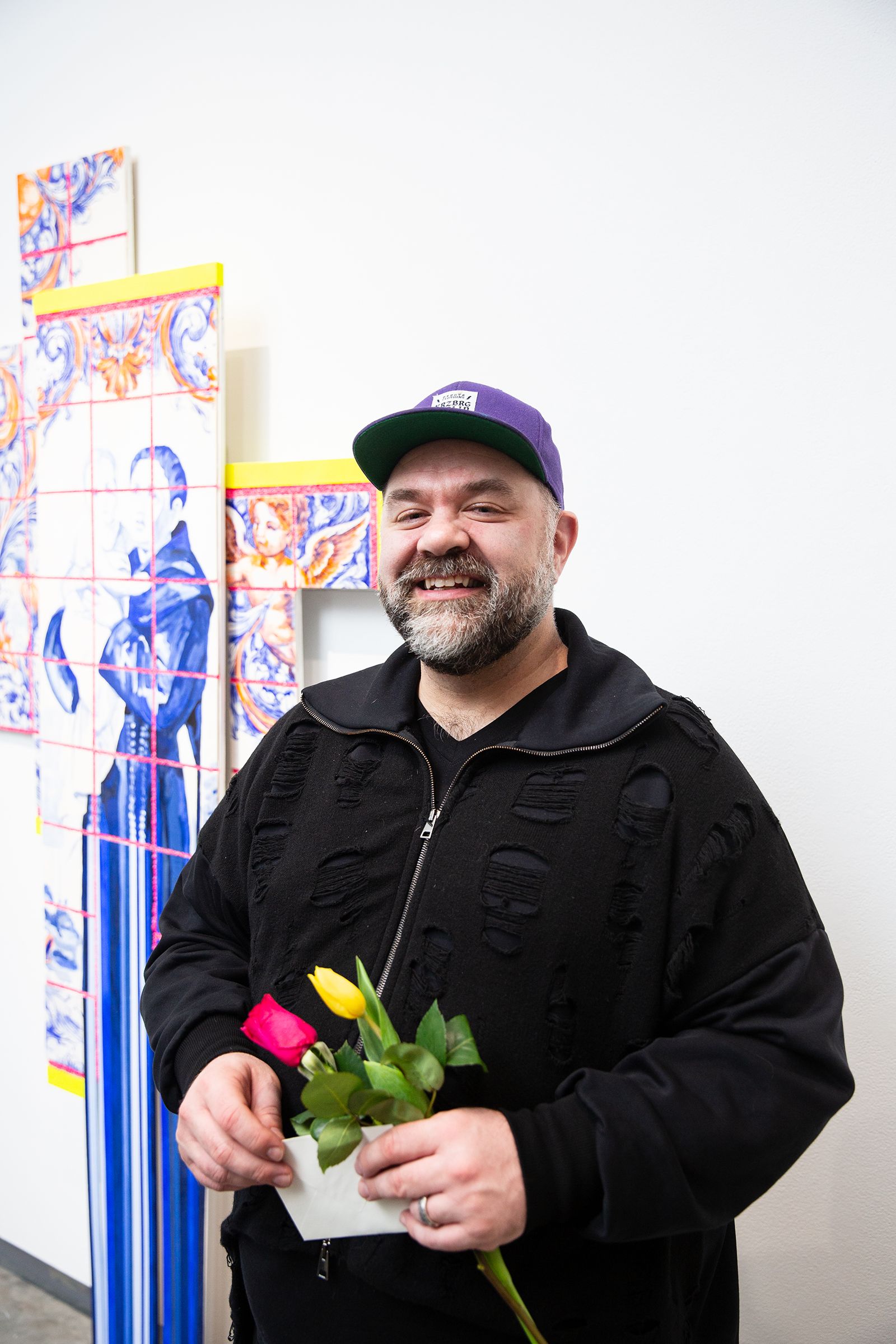
Stephen is a research-based interdisciplinary artist exploring disruptions through materiality, pattern, and performative acts as a means of making space to identify himself within his Portuguese heritage.
Just days after graduating from the Master of Fine Arts (MFA) program, Stephen shared some reflections on his experience at MECA&D.
See Stephen’s MFA thesis project here.
Tell us about your work and approach.
I make non-traditional Portuguese Azulejo tiles with wood, ballpoint pen, tempera, beads, neon colors and pattern; I create time-based performative video works to explore Catholic rituals; and I use reflective materials, rosary beads, and objects to explore sculptural abstractions of tile and repetition. These materials grant me agency to participate in traditional Portuguese practices through acts of disidentification.
What made you choose Maine College of Art & Design to pursue your MFA?
MECA&D was my wildcard school. I had always thought I would pursue an MFA in Graphic Design. Before coming to grad school, I was working in NYC as an Art Director for the past 20 years. I believe a bit of discomfort is necessary to make great work so when I looked at my options to enroll, MECA&D was the only option that felt like a mystery to me. I had always wanted to return to studio art so I took it as an opportunity to throw myself into a completely new experience.
What surprised you most about the program when you started?
The number of opinions in the room. The program starts in June with the first of two summer intensives. During those 8 weeks the school invites two visiting artists each week to give artist talks and do studio visits throughout the week on top of our faculty studio visits. It’s a wonderful way to make new connections and be immediately immersed into the contemporary art scene.
What did you learn about yourself and your practice while you were here?
I learned that curiosity fuels a studio practice. The more curious I became the more chances and opportunities I was willing to take. After my long career in design, the most important thing I learned was what I make and say with my work when there isn’t a creative brief or a client on the other side of the project.
How would you describe your time during the summer intensives?
My time during the summer intensive felt like a time to experiment. Being a low-res student, I’m not around MECA&D’s amenities all year. The summer especially is a time to experiment and see how far you can push your work. I took advantage of large installation spaces and opportunities to learn skills I would not otherwise have acquired like comfortably navigating a woodshop and how to create sound art. The summer was a time to focus on studio without the distractions of juggling other responsibilities that come with being a low residency student.
How have the faculty, Visiting Artists, and graduate advisors influenced your work?
The faculty, Visiting Artists, and graduate advisors are the glue that hold the program together. They are all practicing artists, and each come with their own skillset and areas of expertise. During the summers, faculty and visiting artists play an integral role in getting you to experiment with new ideas and materials. During the fall and spring, my non-resident studio advisor was vital to my success in the program. The one-on-one discussions, mentoring, critiques, and artistic relationships that developed took my work from where I was to where I wanted to be.
How did the MECA&D MFA program prepare you to expand your career in art?
The program has a big emphasis on writing being an important part of the studio practice. Learning different ways to write, whether it is to tell a story or to write a proposal, has left me with a level of confidence and readiness to engage in all the necessary communications the art world expects artists to have a grasp on. The program also pushed me to redefine what my practice is and has taken me to a place where the making, writing, and speaking about my practice are in alignment.
How has the freedom to remain in your home city/town/state influenced your work?
Low residency allowed me to pursue my lifelong dream of earning an MFA while working and tending to family life. You are confronted immediately with the part that others only experience after graduation: you, alone in a studio without faculty members at arms’ reach. It really prepares you to learn how to sustain a practice on your own and connect with your local arts community for support. Everyone at MECA&D are still around too… they are just one zoom call away.
What advice would you give to someone considering the Low Residency MFA program?
My advice is that if you have even the slightest bit of interest/curiosity about getting your MFA and Low Residency is the option you need to take… Just go for it! I was afraid at first that I would feel disconnected from my cohort and the school, but I soon realized it was up to me to decide how much of that interaction I wanted/needed.
You take three courses a semester. One is your studio and the other two are asynchronous. The asynchronous courses are designed in a way that gets everyone involved in each other’s processes of making, writing, and critiquing. Sometimes those courses involve virtual calls as a group and other times you get a series of one-on-one calls with faculty.
The program does a great job at weaving the low and full residency experiences together. On top of spending the summers together in Maine, first-year MFAs have a NYC trip in the spring where the entire cohort spends several days taking in more art than one’s brain can perceive. In the fall of the second year there is an international research trip that is a required component of the program. My entire cohort got to spend a week in Berlin, Germany to visit galleries, museums, residencies, and meet up with local artists. It is truly a memorable experience.